
Why You Should Have a Maker and a Checker When Drafting Your Own Will
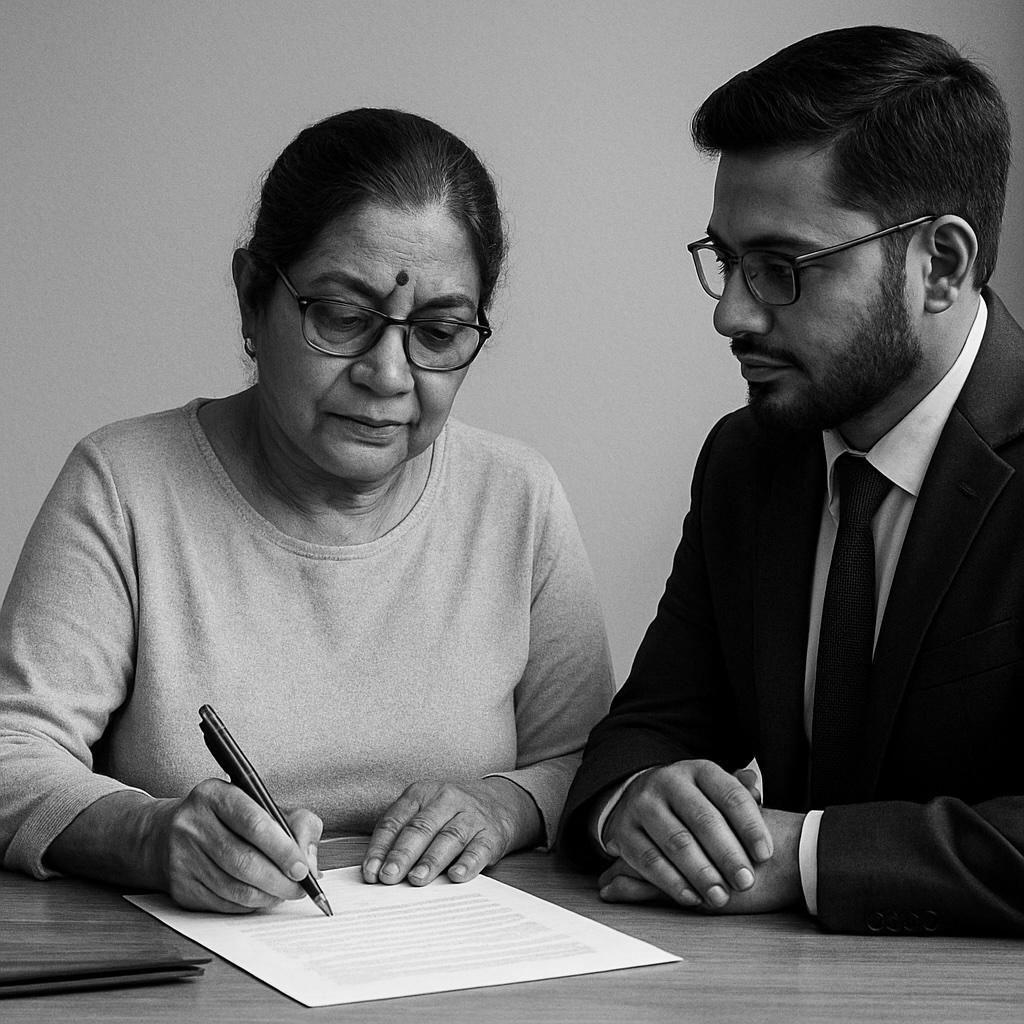
In banking, corporate finance, and software engineering, the Maker-Checker principle (also known as the four-eyes principle) is a standard safeguard: one person prepares or initiates a transaction, and a second, independent person verifies it before execution.
Yet, when people sit down to prepare one of the most consequential legal documents of their lives—their own Will—they almost always act as both Maker and Checker.
It is easy to understand why. Estate planning feels deeply personal, and you know your family and assets better than anyone else. However, drafting your own Will without an independent review increases the risk of ambiguity, family disputes, probate delays, or unintended partial intestacy. While a second pair of eyes is valuable, it does not automatically guarantee that a Will is legally valid—rather, it serves as an essential risk-reduction mechanism to catch gaps between what you intend and what is written on paper.
Unlike a bank transfer or a software bug, errors in a Will are usually discovered after the testator has passed away—when you are no longer around to clarify what you actually meant.
An important legal consideration: The rules governing Wills in India are not identical for everyone. The applicable requirements can depend on the testator's religion, personal law, the nature and ownership of the assets, and the location of the property. The examples in this article are general illustrations and should be considered in the context of the applicable succession law.
The Psychological Blind Spot of Solo Will Writing
When you draft your own Will, you suffer from the curse of knowledge. Because you know the exact context behind every property, bank account, and family dynamic, your brain automatically fills in gaps that are missing from the page.
What reads as crystal clear to you today can look ambiguous—or legally contradictory—to a probate court or a disappointed heir ten years from now. An independent Checker reads only the words on the paper, without your internal assumptions.
An effective Maker-Checker process is not simply about asking another person to proofread your Will. The Checker must independently examine whether your instructions are complete, whether the provisions work together, and whether the document addresses situations you may not have considered. The objective is not to rewrite your intentions but to identify gaps between what you intend and what your Will actually says.
5 Critical Reasons You Need a Maker-Checker Process for Your Will
1. Catching Ambiguous Asset Descriptions and "Phantom" Assets
As the Maker, you might write: "I leave my flat in Bengaluru to my daughter and my mutual funds to my son."
A thorough Checker immediately spots the vulnerabilities:
- Which flat? If you buy a second property later or hold joint ownership, a vague description can trigger confusion or disputes. A Checker ensures clear identifying details—such as municipal numbers, survey details, and registration particulars—are recorded.
- What happens to nominations? A Checker examines whether the nominations made for bank accounts, demat accounts, insurance policies, and other financial assets are consistent with the testator's estate-planning intentions. The legal effect of a nomination varies depending on the nature of the asset and the applicable legislation. A Will should therefore be reviewed alongside existing nominations rather than assuming that a nomination automatically determines the ultimate inheritance.
The Residuary Clause: What happens to assets you acquire after* signing your Will, or assets that you inadvertently forget to mention? A properly drafted residuary clause helps ensure that property not specifically allocated elsewhere in the Will is still distributed according to your wishes. Without an effective residuary provision, assets that remain undisposed of may devolve under the applicable intestate succession law.
2. Preventing Procedural Errors That Create Legal Complications
Where Section 63 of the Indian Succession Act, 1925 applies, an unprivileged Will must meet strict execution formalities:
- The testator must sign or affix their mark at a place that clearly shows the intention to give effect to the writing as a Will.
- It must be attested by at least two attesting witnesses, each of whom saw the testator sign or affix their mark (or received a personal acknowledgment of the signature) and signed in the testator’s presence.
A common mistake is asking a beneficiary, or the beneficiary's spouse, to act as an attesting witness. Under Section 67 of the Indian Succession Act, 1925, where applicable (such as in cases governed by Section 57 and Schedule III for Hindu, Buddhist, Sikh, and Jain Wills), a bequest to an attesting witness or their spouse may become void, even though the Will itself is not necessarily invalidated on that account.
To avoid unnecessary complications, it is generally advisable to select two independent witnesses who do not receive any benefit under the Will. The applicable personal law and statutory provisions should also be considered.
3. Stress-Testing "What-If" Scenarios (Survivorship and Minor Beneficiaries)
Makers naturally write Wills assuming events will unfold in a predictable order—namely, that beneficiaries will outlive them. A Checker asks uncomfortable but necessary contingency questions:
- What if a primary beneficiary predeceases you? Without a survivorship window and clear alternate beneficiaries, shares can lapse or pass to unintended heirs.
- How will assets for minor children be managed? A Checker examines whether provisions for minor beneficiaries adequately address the appointment of a testamentary guardian, where appropriate, and the management, custody, and eventual transfer of inherited assets.
4. Eliminating Internal Contradictions and Alteration Traps
People frequently revise their Wills over time. If a Maker drafts a new Will or adds a codicil without clearly revoking prior Wills—or leaves contradictory clauses across different paragraphs—courts face uncertainty over testamentary intent.
Furthermore, under Section 71 of the Indian Succession Act, 1925, post-execution alterations—such as crossing out or inserting provisions in an already executed Will—generally have no legal effect unless the alterations are executed in the manner required by law. A Checker helps identify such issues and recommends making subsequent changes through a properly executed codicil or a fresh Will, as appropriate.
5. Strengthening Evidentiary Defensibility
Even a carefully drafted or registered Will can still be contested. Under Section 67 of the Bharatiya Sakshya Adhiniyam, 2023 (which replaced Section 68 of the Indian Evidence Act, 1872), a document required by law to be attested cannot be used as evidence unless at least one attesting witness is called to prove its execution, if such a witness is alive, available to the court, and capable of giving evidence.
When a Will reflects structured verification—clear drafting, a named Executor, clean attestation, and appropriate supporting records—it reduces ambiguities that challengers often rely upon when questioning testamentary intent or capacity.
Where appropriate, particularly when the testator is elderly or there may be concerns about mental capacity, obtaining a contemporaneous medical assessment can provide additional evidence of the testator's sound disposing mind at the time of execution. This is a precautionary measure rather than a mandatory requirement for every Will.
How the Maker-Checker Workflow Works in Practice
Who Should Act as Your Checker?
A Checker should ideally be independent of the beneficiaries and free from conflicts of interest. This helps reduce questions about undue influence, bias, or whether the testator's instructions were independently examined. While an Executor's primary role is to administer the estate after your passing, legal verification of the draft is best handled through:
- An independent succession lawyer experienced in Indian testamentary law and registration practices.
- A qualified legal reviewer familiar with applicable personal succession laws.
- A structured Will-drafting platform with built-in validation checks, supplemented by professional review where necessary.
What Does a Maker-Checker Review Actually Look For?
Whether you are reviewing a draft yourself or using a structured workflow, a thorough verification checks six core areas:
- Asset completeness: Are all relevant assets accounted for, and are their ownership details clear?
- Beneficiary clarity: Are beneficiaries correctly identified, with clearly defined shares?
- Contingency planning: What happens if a beneficiary predeceases the testator?
- Residuary provisions: Is there a provision for assets not specifically mentioned?
- Execution formalities: Are the applicable witness and signing requirements addressed?
- Personal-law considerations: Are there any restrictions arising from the testator's personal law or ownership rights?
Draft Your Will with Greater Confidence on iWills.in
A second pair of eyes can make all the difference. A Will is too important to be drafted and reviewed entirely through the same perspective.
Writing a Will is about more than listing your assets and deciding who should inherit them. It is about ensuring that your intentions are clearly documented, potential gaps are identified, and the document addresses the situations that may arise in the future.
At iWills.in, our guided online Will maker helps you organise your assets, identify beneficiaries, structure inheritance provisions, and address important considerations such as residuary clauses and contingency planning. Think of it as bringing structure and checks into a process that is often undertaken alone.
Don't just write your Will. Take the time to review it.
Start creating your Will at iWills.in and take an important step towards giving your family greater clarity and peace of mind.
Share this article
Join 10,000+ Indians who have secured their legacy with iWills India.