
Can You Leave All Your Assets to Charity? What Indian Law Says About Philanthropic Estate Planning
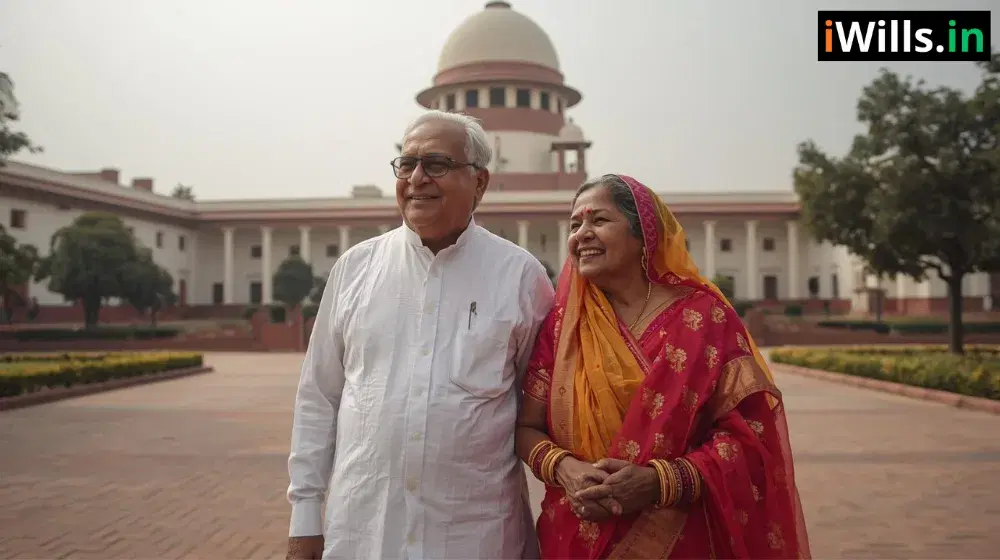
When people think about writing a Will, the traditional narrative revolves around securing the financial future of children, spouses, and close relatives. However, for a growing number of testators, estate planning is also a profound opportunity to leave a lasting legacy through philanthropy.
On platforms like iwills.in, one of the most compelling questions we encounter from users is: "Can I give all my assets to charity?"
The short answer is yes, with important legal nuances. While Indian law strongly upholds individual testamentary freedom, that freedom is not absolute. It must be balanced against valid testamentary interests, statutory maintenance obligations, and the specific rules of applicable personal laws. Here is a detailed legal breakdown of what you need to know before dedicating your estate to a cause close to your heart.
1. Valid Testamentary Interest: Self-Acquired vs. HUF and Ancestral Property
Your ability to donate assets depends heavily on the legal nature of the property and whether you hold a valid testamentary interest in it:
Self-Acquired Property: A testator generally has the legal capacity to dispose of property they acquired through their own earnings, purchase, or valid gift/inheritance, provided they are of sound mind and major. However, saying all* self-acquired property can automatically be bequeathed without restriction is oversimplified; the testator must hold ownership and a valid disposable interest at the time of death, keeping in mind that assets subject to mortgages or other encumbrances may still be bequeathed subject to those existing legal obligations and rights.
- Ancestral and HUF Property: The assumption that a person can never touch ancestral property for charity is too broad. Under Section 30 of the Hindu Succession Act, 1956, a Hindu is legally permitted to dispose of their own undivided coparcenary interest in Mitakshara coparcenary property by Will. However, an individual cannot ordinarily bequeath the entire Hindu Undivided Family (HUF) property as though it were exclusively their own; the extent of disposition is strictly limited to their individual coparcenary share.
2. Navigating Personal Laws and Statutory Restrictions
India does not have a single uniform civil code governing inheritance; instead, succession rights are governed by personal laws that place distinct boundaries on testamentary powers:
A. Hindu Succession Act, 1956 & Maintenance Obligations
For Hindus, Buddhists, Sikhs, and Jains, Section 30 of the Hindu Succession Act governs testamentary succession.
Maintenance Rights of Dependents: It is incorrect to assume a charitable Will is automatically invalid if a dependent is omitted. Instead, under Sections 21 and 22 of the Hindu Adoptions and Maintenance Act, 1956, specific categories of eligible dependents (such as an aged parent, minor child, or dependent wife) may claim maintenance from the estate inherited* by those who take it. Readers should understand that while testators enjoy broad testamentary autonomy, ignoring statutory maintenance obligations can lead to legal challenges over the estate distribution.
B. Muslim Personal Law (Shariat)
Under classical Islamic jurisprudence, testamentary freedom is strictly regulated to protect heirs:
- The One-Third Rule and School Differences: Under traditional Sunni testamentary rules, a bequest to a non-heir—including a charitable organization—is generally restricted to a maximum of one-third (1/3rd) of the net estate after the payment of funeral expenses and debts, and exceeding this limit requires the requisite post-death consent of the legal heirs. However, Sunni and Shia rules are not identical; for instance, under Shia law, a testator may validate a bequest up to one-third to certain heirs or non-heirs without necessarily requiring co-heirs' consent in the same manner. Because these rules vary significantly across schools and individual circumstances, testators governed by Muslim personal law must obtain specialized legal verification rather than relying on a uniform rule. For foundational statutory context, reference may be made to the Muslim Personal Law (Shariat) Application Act, 1937 alongside authoritative legal treatises on Islamic succession.
C. The Indian Succession Act, 1925
The Indian Succession Act, 1925 governs succession for various communities (such as Parsis and Indian Christians), but it does not apply in the exact same manner across all groups or marriage frameworks. The applicable succession regime depends heavily on the testator's community, the specific marriage law governing them (such as the Special Marriage Act, 1954), and relevant statutory exclusions. Professional legal verification is strongly recommended.
3. Tax Implications: Lifetime Donations vs. Testamentary Bequests
Many testators assume that obtaining tax-exempt status (such as 12A and 80G approvals) for a recipient charity automatically confers a tax deduction on the testator's estate or the recipient merely because a gift is made under a Will.
- The Legal Distinction: A recipient charity's registration or approval does not automatically translate into an active tax deduction under Section 133 of the Income-tax Act, 2025 (which governs deductions for eligible donations under the current governing tax legislation) unless specific statutory conditions—such as making donations out of taxable income under the applicable tax regime within qualifying limits—are strictly fulfilled. Readers should verify current tax provisions with a chartered accountant, and note that historical concepts like estate duty do not apply as current routine considerations.
4. Refining the Cy-Près Doctrine and Practical Safeguards
If a specified charitable purpose cannot be carried out as originally intended, the legal outcome is not automatic.
The Cy-Près Principle: The doctrine of cy-près* permits a court to redirect charitable funds to a similar purpose in appropriate circumstances where the original objective becomes impossible or impractical to fulfill; however, its application depends entirely on the specific facts, the wording of the Will, and relevant legal principles.
- Practical Safeguards for Testators: To avoid ambiguity or litigation, testators should adopt robust practical safeguards:
- Verify Exact Details: Verify the charity’s exact legal name, official registration details, current existence, and legal capacity to receive bequests.
- Specify Intent: Clearly clarify whether the gift is intended for the charity’s general corpus or a specified project.
- Alternative Beneficiaries (Recommended): Include a carefully drafted alternative-beneficiary provision or contingency clause as the primary practical safeguard detailing precisely what should happen if the primary organization or project ceases to exist.
Legal Disclaimer
Disclaimer: This article is for informational purposes only and does not constitute formal legal advice. Succession rules, personal laws, property classifications, and testamentary capacities vary significantly based on individual circumstances, religion, and the nature of ownership. Readers contemplating a complete or partial charitable disposition of their assets should obtain appropriate independent legal advice.
Ready to secure your legacy? Explore structured, legally sound digital Will drafting tools tailored for Indian succession laws at iwills.in.
Share this article
Join 10,000+ Indians who have secured their legacy with iWills India.